Showing posts with label 1994. Show all posts
Showing posts with label 1994. Show all posts
Thursday, March 5, 2026
Interview with Kylie Budin
Seems like I've forgotten to post the interview with Kylie Buddin I received last year (you can also read the transcript here), so here it is...enjoy!

Monday, June 23, 2025
Christmas quotes:
"Oh gee, it's gotta be a cross between the Memphis Les Paul copy I got for my 16th birthday and the Evel Knievel doll-you know, the acton figure that sits on the motorcycle-that I probably received maybe five years before. The Evel Knievel my grandmother gave him to me, and it got me so deeply that I cried and I put my arms around her 'cause I knew she loved me so much. The guitar, everybody on my mom's side of the family chipped in. And that was a great, great thing."-North County Times, December 22, 1994 (some musicians share their favorite gifts)
.
.
.
Tradition and memory come into play strongly over the holidays...just ask Jeff Buckley. "I've always recognized Christmas as a traditional thing. It's just mainly the smell of the tree, and the food, and the sound of presents being unwrapped-the one toy that totally hits the kid right between the eyes. That's great. Not seeing people for a long time and having them be there at Christmas. And leftovers.
" We all converge at my grandma's house, but she just moved from the house she lived in for 25 years that I've known since I was a child as The Christmas House. Also, my family are splintered. There's this weird feud that nobody even knows what the origins are anymore, and they're all retarded. So I don't know what the hell will happen this year."
Alas, neither naughty or nice can get even Mr. Buckley his special gift: "What I want most for Christmas is free time in New Orleans. The last time I was in New Orleans, my mother showed up. You're in the sexiest city in the world, and you're f****** mother flies in."-Chart, December, 1994
Monday, February 10, 2025


Tuesday, October 1, 2024
Buckley's haunting songs are mesmerizing
The Star Ledger: February 28, 1994
By Ben Horowitz
Jeff Buckley, a unique, improvisational electric guitarist and singer, accomplished a number of rare feats during his solo performance on Saturday night at Maxwell's in Hoboken.
When he played a lilting, chiming version of Edith Piaf's "Je N'en Connais Pas La Fin" (I Don't Know the End), the packed house stood still in utter silence. As tears filled his eyes during the final, dreamy refrain of "oh, mon amour," the song suddenly ended and the only sound before the applause was a young woman's one-word reaction: "Wow."
It was like that during most of his set. Patrons at Maxwell's and other clubs generally talk and move around while the music is going. But Buckley-an intense eccentric with talent dripping from his fingertips-commanded the audience's complete attention.
Meanwhile, his slow to mid-tempo, extended numbers were defying categorization.
During "Grace," for example, his guitar changed from airy, high riffery with jazz-like chord changes to heavy, dissonant licks with a Jimi Hendrix influence. At the time his singing was shifting from falsetto chants to scats to emotional verses.
Buckley headlined a diverse, eclectic double bill where the opening act was Kate Jacobs, a wonderful country-rock singer songwriter who remains Hoboken's best-kept secret.
Buckley's boyish, art student-like good looks and troubled presence strongly recalled his father, the late Tim Buckley, best known for the haunting, ethereal hippie anthems on his classic 1967 folk-rock album, Goodbye and Hello.
The elder Buckley moved to avant-garde jazz before dying from a drug overdose at the age of 28 in 1975.
Jeff Buckley's voice is about two octaves lower than his father's, but it shares Tim's tortured intensity and experimental tendencies. Ironically, Jeff recalls meeting his father only once after Tim split from his mother in 1966, the year Jeff was born.
Jeff, under contract with Sony/Columbia Records, could be headed for stardom, but he does seem guaranteed of at least cult status. His debut EP, Live at Sin-e, came out last year and Columbia expects to release his first full-length album in the spring.
During the Maxwell's show, Jeff Buckley's guitar virtuosity showed a wide gamut of influences: He sounded like Jimmy Page meeting Stanley Jordan on an ominous, cloudy day.
Buckley opened the show with an extended a capella chanting in a black spiritual style before moving into verses accompanied by jagged, dissonant, jazzy guitar riffs on "The Last Goodbye."
"Mojo Pin" found Buckley shifting from a jazz take on the English folk-style riffs sometimes favored by Led Zeppelin into heavy, feedback-drenched segments.
Buckley came closest to his father's sound on "Forget Her," a haunting, melodic, passionate song in a folk-jazz vein.
Buckley's set peaked with the Piaf song, which came towards the end and was so gorgeous and refined it rendered the final two numbers anticlimactic.
Buckley was on stage for less than an hour, but that was enough soul-searching intensity for one night. Had the set gone on much longer, it would have been like having an unnecessary, extra portion of a rich but filling delicacy.
Impressive Buckley
Now magazine: February 17, 1994
By Tim Perlich
Submitted by Karen Pace/Steven Bodrug
Jeff Buckley, opening for Wind May Do Damage, with Rory McLeod, at Ultrasound, Sunday, February 13. Attendance: 175. Tickets: Free. Rating: NNNN (highly entertaining)
Without fanfare, a disheveled Jeff Buckley, in an oversized new coat, took the Ultrasound stage with a confident New York spring.
The between-set chatter of the near-capacity crowd slowly dissolved, more out of curiosity than deference. As the spindly singer/songwriter started to twiddle his pick against the strings of his low-slung Telecaster, you could see a moan beginning to take shape in his throat.
When he finally opened his mouth, a strange, weeping howl leapt out and filled the room. People stopped drinking in mid-gulp. The club became very, very quiet-so quiet that between Buckley's breaths the only sound was the air being sucked through the ceiling vents.
The great care he took in building his song shapes made it known that this wasn't going to be Tim Buckley's son trying to use his good family name as leverage in promoting his debut "product." Nope. Those sounds belonged solely to Jeff Buckley, and he was excreting them because it's just a natural bodily function.
His guitar playing technique is surprisingly accomplished. Buckley strikes chords with the self-assurance of a music school grad who no longer feels obliged to drop suspended sevenths and diminished ninths just because he can. The brief time Buckley spent alongside serious slinger Gary Lucas in God's And Monsters clearly served to set him straight.
Yet you tend to forget he's even strapped in when that voice swoops up in a piercing falsetto, then comes crashing down in waves.
Buckley is still stretching, still testing his limits. There are moments where he flutters with a grand flourish where a simple whisper might have conveyed so much more. His banter sometimes betrays a certain greeness. You could sense the entire house cringe when he noted with surprise that there was "actual Jamaican-style jerk chicken in Toronto." Fortunately, quickly sensed an impending brush back and acquitted himself admirably by pleading ignorance.
For an encore, Buckley came back with an impressive 10-minute deconstruction of Sweet Thing. It's no small task to take on a Van Morrison song-they come so thoroughly marked with Van's own personal stamp-but Buckley stylishly delivered it like something he'd written on the cab ride over. Nice one.
Friday, September 27, 2024
Next big thing tag no sweat for gifted singer Jeff Buckley
Now: February 10, 1994
By Tim Perlich
Submitted by Karen Pace/Steven Bodrug
Jeff Buckley, with Wind May Do Damage, and Rory McLeod, at Ultrasound (269 Queen West), Sunday, February 13, 8 pm. Free. 593-0540
Jeff Buckley, at C'est What (67 Front East), Monday, February 14, 8 pm. Free. 867-9499
Ever since Elvis enlisted, there has been an opening for a young free spirit to step forward and take over as America's larger-than-life celebrity saviour.
For the past three decades, Columbia Records has led the star search. Bob Dylan looked like a shoo-in before the motorcycle mishap. And for a minute, Bruce Springsteen was a solid contender-except those three-hour concerts never did translate in the video age. But Columbia may have stumbled upon a winner in Jeff Buckley.
It's still too early to tell, but the handsome 26-year-old singer/songwriter, who grew up in "white trashvilles across California," appears eminently qualified for the job of cross-generational musical icon.
Before he ever set foot in a recording studio, the myth-making cogs of the music industry machine were already turning his way. The fact that the son of the hauntingly voiced Tim Buckley, who died tragically in 1975, was showing a musical inclination was all legend starved rock writers needed to know to christen the kid Next Big Thing.
In the midst of all the hoopla, no one thought to ask the young Buckley if he had any interest in being king.
"I've never approached a record label in my life," says Buckley from his hotel bed during a stopover in Austin. "I never thought about signing a record deal, I never even thought about being a musician-it's just something I did from the time I was a child. Now I'm beginning to go deeper and deeper into it. I haven't really achieved anything significant.
Folk label
"I've been in bands since I was 13. I was playing with a band in New York but it wasn't making any money, so I had to start doing solo gigs to pay my bills. But I've never been into the Bob Dylan thing. I don't consider myself a folk singer, although people have been calling me that lately. Anytime somebody stands on stage by himself, people want to call it folk music. It's just music-my music.
"Playing solo was important for me because I needed to listen to where my music was heading. I knew that in such a setting I would find the voice leading me back to the origins of a sonic philosophy from which the rest of my music would come. I didn't want to be just another dickhead with a guitar singing about his stupid life."
It was Buckley's stint with Gary Lucas' Gods and Monsters that first brought the out-of-towner some downtown New York Street cred, but it was his solo shows at Café Sin-é-a hip East Village hole-in-the-wall where artists like Sinéad O'Connor slip in for impromptu acoustic shows-that led to his Columbia deal and the four-track Live At Sin-é foretaste of his Andy Wallace-produced debut extravaganza.
Truth beneath covers
Recorded over the month of August, Live at Sin-e's stripped-down covers of Van Morrison's The Way Young Lovers Do and Edith Piaf's Je N'en Connais Pas La Fin are perhaps more revealing than the two originals included.
Not only do the cover choices confirm Buckley's refined taste, they also show off his considerable interpretive skill and his versatility. And his unself-conscious scatting and the ease with which he spontaneously tacks on an extra verse to an etched-in-rock Van anthem shows he's not opposed to taking risks for the sake of greater achievement.
"There's nothing about the EP to give you a clear indication about what's to come," he says. "There'll probably be critics who'll take it to show I'm a zero and have nothing to offer while others may accept it for what it is. The whole thing was an immediate, instinctive experience. I just decided to do some scat singing. It's not about trying to imitate Ella Fitzgerald-its just a matter of finding a way of improvising."
So far Buckley hasn't had to deal with much negative criticism-if any. Whether it's out of guilt for the recognition his talented father never received, or the simple thrill of the grandiloquent"I have seen the future of rock and roll..." stroke, the journalists who have covered Buckley seem determined to create a legend, whether he's willing to play along or not.
" I can't protect myself against writers," he grumbles contemptuously. "I don't know why, for example, Bill Flannigan took such a myth-making approach in that (February 1994) Musician article. You know that part where he made a big deal of my staying on stage alone for the encore as the rest of the band left? The whole incident was so very ordinary.
"The show was being broadcast live on a radio station where a friend of mine is a DJ. He said, 'come out and do another song,' so I played a song we did early on in the set. That was it. I can't defend myself against writers who want to inject their own flourishes.
"I really don't know why music critics exist. They don't fit into the context of what I'm doing. If you weren't there and you didn't taste the experience, you ain't gonna get it. I don't see how the music I make can be accurately expressed in literary terms. Instead they focus on what I look like or my record deal.
"To any real people who might be reading this, I submit, don't listen to writers. Either come and see me perform or ignore me-but listen to your heart."
Monday, September 23, 2024
Gabe's Oasis review
You Could Do Worse #3: Winter/Spring 1995
By Michael F. Nameche
The Grifters/Jeff Buckley
Gabe's Oasis-Iowa City, IA
9 July, 1994
Stories abound about Jeff Buckley. Before his band took the stage, my ear had collected enough second hand information about the man that I felt weighted down. I quickly decided that such rumors belong somewhere other than a live review, but to his credit, I will say that Buckley is widely regarded as "a really nice guy." Having already established the fact that he can hold a crowd a crowd captivated on his own, (check out the 1993 EP, Live at Sin-é, for the indisputable proof), Buckley brought a top-notch band to back him up on this tour. They wisely chose "Mojo Pin" as the opener, and the crowd was in rapt attention from then on.
Visually, he was mesmerizing; every note he sang registered somewhere on his face with an emotive twitch or ripple. Toothpick legs held in a Joey Ramone stance, Jeff's stage presence burned with quiet intensity. Buckley's voice is truly incredible, an angelic coyote moan. His guitar playing is the perfect companion to that voice, often haunting and very impassioned.
Buckley belongs among an elite group of guitarists that draw from a wellspring of unexpected emotion, something that everyone can relate to, and on this night it was obvious that the impact of what he was offering to the audience was not lost.
Wednesday, July 17, 2024
HMV Toronto
Newly unearthed footage of Jeff and the boys on October 27, 1994 at the HMV in Toronto, Canada...enjoy!
Tuesday, February 6, 2024
Buckley's Cafe Society
The Toronto Sun
Tue Oct 25 1994
BY JAMIE KASTNER
(Submitted by Steven)
Some people do yoga to unwind. Others do drugs.
Jeff Buckley, singing/songwriting son of tragic folkie Tim Buckley, makes cappuccino in his favourite cafe, the Sin-e in New York's East Village.
"When my head gets tight, I go down there and wash dishes or make cappuccinos," he says from his Manhattan pad. "I used to handle the money, but that was going too far. Now, I just make cappuccinos."
Occasionally, Buckley steps out from behind the Gaggia and straps on an electric guitar. In fact, his debut EP released early this year was called Live At Sin-e.
On Grace, the full-length CD which came out in August, Buckley blends his octave-scaling voice with everything from solo guitar to full band. The songs range from from Buckley originals to his take on Nina Simone staple Lilac Wine. He'll be dispensing in person Thursday at the Trinity Centre.
Now, on that cappuccino question. You might figure a cafe for a relaxing enough hangout without actively having to sling foam. Apparently not the Sin-e.
"It's more relaxing behind the counter than in the audience. Sometimes we get these acoustic bands playing really loud. They're like: 'We're not faggots - it takes a real man to play an acoustic guitar!' It's what's said that should intoxicate, not how loud it's said."
Buckley's had to prove his volume theory beyond the Sin-e's familiar brick walls.
"At one of the best shows I've played, in Iowa of all places, the Damn Builders and the Grifters opened up for me. They came out and really rocked the house - they do this rockabilly thing.
"And then we get on and we're like a down pillow in comparison. We had to draw people in with our playing alone - although we did play loudest we've ever played."
Musically, Buckley's attention to dynamics can be traced back to influences ranging from Gershwin to Nusrat Fateh Ali Kahn. (He never knew his musical father, who died in 1975, and has little to say on the subject). Buckley also draws inspiration from the printed page.
"I've got a real Ginsberg head-groove on. I'm also into really weird fiction - I'm reading this novel called Turtle Boy." A five-minute summary of the travails of Turtle Boy ensues.
"And do you know Ayn Rand?" A 10-minute lecture on the life of Ayn Rand and the philosophy of rational self-interest.
"I'm really into biographies too. I read Nina Simone's recently. Amazing. I like knowing what happened in other people's lives. I guess it's a way of getting away from my own."
© 1994 Sun Media Corporation. All rights reserved.
Saturday, December 9, 2023
MM Grace review
August 13, 1994
JEFF BUCKLEY
GRACE
Columbia Col475928
10tks/55 mins/All formats/FP
BECAUSE, after a series of desperate but sadly unsuccessful attempts, he finally realized that it wasn't actually possible to carve lyric poetry into the night sky with a 300-foot flamethrower, Jeff Buckley became a singer.
"Grace" puts me in mind of what all those bands formed by young Hollywood stars might have sounded like if Hollywood was still HOLLYWOOD, and the square-jawed buggers could boast a single grain of stardust between them-partly due to Jeff's movie-star looks, cool-Californian stage persona, and his habit of talking wonderfully incoherent Utopian stoner babble, but mainly because near enough all these songs are awash with the drama and mystique they first built 25-foot screens for.
In "Mojo Pin", a choked, meandering vocal weaves through ornate ripples of open-tuned guitar; the title track boasts a chord sequence to cartwheel to. Elsewhere he adds a wonderful feel of doomed, youthful romanticism to covers of Leonard Cohen's "Hallelujah", the "Corpus Christi Carol" and, rather more bizarrely, "Lilac Wine" by perennial "Two Ronnies" guest Elkie Brooks.
"So Real" is a song of surrender to the raised-vein thunder of The Moment (being, in this case, a night when Jeff and some pretty chum "walked around till the the moon grew full, like a plate, and the wind blew an invocation"). He never stepped on the cracks because he thought he'd hurt his mother.
"I love you," whispers Jeff. "And I'm afraid to love you." My Bloody Valentine once conveyed that sudden, shocking self-realization with a mesh of bleeding noise; Buckley uses his voice, drawn out like a slow-stretched bolus of heavenly bubblegum (Alright!!!-Ed).
It's a voice that leaps tall buildings in a single bound, smells of sex and Chanel and never stoops to showboating. Dull people would remark "He could sing his shopping list and it would sound fantastic," (Like, YOU'D never slip it in a review, right?-Ed) which, luckily, legitimizes his more embarrassing stabs at lyrical flash. Indeed, when Jeff sings about girls with green eyes and "butterscotch hair", you don't just picture them, you fancy them rotten (but that's the thing about the Nineties, don't you think? The most alluring quality one can possess is to be fictional). Anyway, "Grace" is a massive, gorgeous record, a record that floats all talk of famous dads out onto the lake on a makeshift raft and leaves it there, and starts where every other singer-songwriter in town says, "Whoa!", pulls up his horse and backs off.
Because the point at which others are struck dumb with rapture is the moment Jeff Buckley finds his voice, and starts singing.
Jeff Buckley appears on the MM stage on Sunday, August 28
TAYLOR PARKES
Friday, December 8, 2023
MM Sin-e review
April 9, 1994
JEFF BUCKLEYLIVE AT SIN-E
Big Cat ABB61XCD/4tks/27 mins/MP
FOLKIES-Arran sweaters, sandals and a face that would disgrace even Captain Birds Eye after a night on the lager. Jeff Buckley-young and electric with the kind of fanny-moistening good looks only a Hollywood surgeon could chisel. And he can write a good tune too. Nirvana!
The highlight of Buckley's two recent London shows was to watch someone actually working for their wage-going for notes which, by rights, they had only an even chance of hitting, yet, in the process, creating an atmosphere which left everybody in the room stunned into silence.
This four-track mini-LP (fat bastid of a single?) retains the edge an abandon that characterized those shows yet, because it was recorded in a tiny bar in Greenwich Village, loses none of the intimacy that makes JB so special live. Take the lovelorn "Mojo Pin", with its dreamily insistent guitar motif that sounds like it's been beamed in from the edge of sleep or "Eternal Life" which starts off like the most depressed Hendrix reflection then turns inward into a drama-filled confrontation with his own mortality.
Buckley's version of Van Morrison's "The Way Young Lovers Do" is a fine example of what I was on about earlier, his cavalier approach to creating time-stopping, wonderous moments.
He actually picks out the individual instruments from the thick mesh of the "Astral Weeks" big-band arrangement and wails, hollers, cries, and croons their parts. Somehow, none of the churning urgency of the original is lost. It could so easily be a grand folly but isn't, simply because of his sheer brass-neck, his intuitive knowledge of what made the song so brilliant in the first place and the small fact that he could sing the wallet out of Pavarotti's back pocket.
I get blank looks trying to order a vodka in Paris, but I think "Je N'en Connais Pas La Fin" is one of those heart-destroying paeans to lost youth that only the frogs-Edith Piaf and Jacques Brel (I know he's Belgian) knock out so lovingly.
Jeff Buckley has created one of the albums of the year with just a Telecaster and a voice that sounds like a choirboy singing from the rafters of a whorehouse. Buy it and melt.
MAT SMITH
Thursday, September 7, 2023
Grace Under Pressure
The Advertiser: December 15, 1994
By Mike Gribble
Jeff Buckley met his dad, 70s rock contemporary Tim Buckley, only once but in music both have been struck by a similar sense of love-sickness and devotion to raw, spontaneous passion. Jeff Buckley's debut album, Grace, is a soaring, unique mix of styles, without consistent or specific direction, but is underscored by lyrics pleading for understanding.
Buckley's voice carries flecks of operatic strains, rock angst, and even reveals glimpses of child-like hesitancy. Captain Beefheart guitarist Gary Lucas paints Buckley's soundscapes with sparse and well placed caresses of strings.
"A trademark of my presence has been that, at first glance, people either hate me and run away screaming, or we sit down and talk and get on with knowing each other," says Buckley, 27. "I've lived in bars since I was 14, doing gigs in southern California. I remember any gigs I did had a lot of range to them but I didn't do things with the same focus I have now.
"Music is a force of nature; it's not really an art. The conventions built around music are art forms. I experience music as being like the wind, or ocean, or fire.
"It comes perfectly natural to humankind. It gets into the bloodstream and you can hate it, or it can totally elate you.
"Initially, songs come to me very easily but bringing them to full bloom takes a lot out of me. The way you see the song in your mind and the shape it takes...if you see any apprehension in the song, that's usually the way it came out when I first did it and I don't like to change it. I don't like to say it any better than that. I'm hard-pressed to find a different expression for it.
"If it's a little rusty at the beginning, if it's like stars gathering in the galaxy, that's the way it comes out.
"I love the place music takes you. It's like a whole other universe where all musics exist. Music takes time and it takes moments for people. It hovers like flies over a picnic before it goes in for the kill and you really...like, really experience it."
- Jeff Buckley will perform at the Big Day Out in Sydney and Melbourne. Adelaide fans should start requesting an SA visit through Sony Music.
Saturday, August 12, 2023
Fall 94 tour flyer
A flyer for the fall 94 "Grace" tour
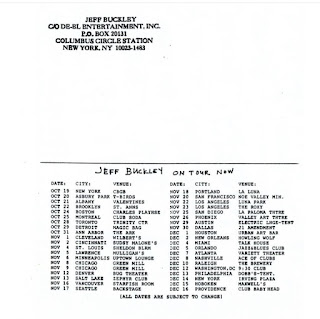

(Edits: Sony National Branch Meeting was on Dec 7, not 💯 about the Ace of Clubs, but it seems to have been scrapped in favor of the Sony thing, Club Babyhead was on the 14, Irving Plaza was on the 17, Maxwell's on the 18 and was the finale)
Thursday, December 22, 2022
Troubadour shows "Grace"
The State News: November 1, 1994
Written and submitted by Chris Solari
FERNDALE--The bag contains...a small room, a few people and good ol' fashioned rock 'n' roll.
Of course, for those few people who did pile into The Magic Bag Theatre in Ferndale Saturday, the real sorcery and wizardry of the Halloween weekend was performed by Jeff Buckley.
Buckley, who recently released his full-length debut "Grace" this fall, dazzled the crowd of about 250 people in the small movie theater-cabaret setting and lived up to his growing fame as a tremendously overwhelming live performer.
Opening act Brenda Kahn, who will release a recording in February, warmed the crowd up with a great mix of eclectic alternative and beautiful rock numbers with her very intense voice-sometimes angelic, sometimes devilish.
But the crowd grew extremely restless waiting for Buckley to take the stage. When his group came out after what seemed a lengthy intermission (even though it was only about 15 minutes), not a word was spoken, performer or audience.
The theater grew dark, save for a ghastly orange glow set around Buckley and his guitar. What followed was five minutes of guitar play that would have made the devil himself cringe had the beast been there. Buckley used his extensive vocal range to emanate monk-like moans and wails from the gloomy light that haunted the small theater.
Buckley strummed languidly through the very trippy intro before leading into the notes to his first song on "Grace," titled "Mojo Pin."
He then followed up with another song from his debut LP-"So Real." The song started off with Buckley singing softly and serenely with his guitar and drums, then kicked in and out of tempo before the electric culmination. And Buckley's facial expressions while singing gave everything from angst to happiness to amusement to pain.
Buckley did more tunes from "Grace," such as the title song and his version of the folk classic "Lilac Wine" while mixing playful banter with the audience. Those who paid the minimal $12 fee to see the show felt almost as one in the intimate atmosphere.
Following "Lilac Wine," which showcased the tremendous voice of Buckley, a member of the audience shouted a request for him to sing "Sweet Surrender" by his late father, Tim Buckley. The woman even had the audacity to question Jeff Buckley's vocal range. The younger Buckley almost took offense to this, quipping back at the woman, who responded by saying she loved his music as well.
"Do you see me up here? You see something that is no longer here," he politely, yet scornfully told the woman.
With that, he launched into a number which he said was, "about love in any f**king generation." The opening chords sounded different, but the slide came out and Buckley tore into the third track on "Grace," "Last Goodbye." Tossing the slide aside, he hit a driving pace with his guitar and followed up with the song's touching lyrics.
After hearing the conversation between Buckley and the woman in the crowd, I finally figured the song out. To me, the tune is almost a tribute to the father who died while his son was young. And the pain in the singer's eyes...the lyrics and his face emanated his sorrows.
Most of the older crowd who were hoping for the performer to be his father left, leaving the true fans and music lovers.
The only drawback to the show was technical problems. A low, annoying hum from the amps could not be corrected until almost the end of the show. But Buckley, who proved himself as a virile comedian as well as musical genius, joked about it and told the crowd there were problems- not trying to side-step the issue at all.
Buckley went in to do some great numbers, like "Lover, You Should've Come Over" and the electrically powerful "Eternal Life" that showed Buckley's voice was more than that of a troubadour. He can rock with any musician and singer out today.
He closed with a number that, of all things, included a cello. "Dream Brothers" was a perfect end to a great set, and the remaining crowd beckoned him back for an encore.
In the future, watch for Jeff Buckley if he pops up around the area-his show is one that no man, woman, child, dog, cat, ect, should miss.
Grace review
The State News: September 14, 1994
Written and submitted by Chris Solari In one of the most anticipated full-length debuts of the year, singer/songwriter Jeff Buckley comes out with a bang.
After his live, four-song EP "Live at Sin-é" hit the streets last March, Buckley, son of folk-legend Tim Buckley, began to gain more critical success. He received rave reviews from Rolling Stone and Spin.
Buckley put studio versions of two songs from "Live at Sin-é" on "Grace." But this tim, he puts a talented band behind his powerful guitar playing ability, making the lead track "Mojo Pin," and track nine, "Eternal Life," (both appeared on Live) a more complete reality than the man-and-guitar versions on the debut.
The height of the release is "Last Goodbye," a powerful song that shows off a fabulous bass line, some tremendous riffs, and Buckley's powerful vocal magic.
It's a touching song-actually giving the roller-coaster emotional feeling of saying farewell to a departing loved one.
"Lilac Wine" is another strong song, focusing primarily on Buckley's vocals and lyrics. It is a slow, quiet number that let's Buckley and his message take center stage.
But the studio version of "Eternal Life" packs the biggest punch on the release. A hard-driving electric guitar opens the track, and rips apart the mellow feeling of the other songs-showing just how deep Buckley's music can go.
"Grace" shows that Buckley can take many forms, and he can truly shine from behind his father's shadow.
Wednesday, December 21, 2022
Jeff Buckley: Knowing Not Knowing
Quotes from the book Inside The Music by Dimitri Ehrlich (interview done December 17, 1994 after the Tower Records show...you can also read his review of the show here)
"What I'd love is if a deejay had a lineup of songs, and he'd just use one of my songs as part of a really nice evening. But that's the way I would deejay, not the way they do it. They usually have playlists."
"If it happens it'd be great, but we just play to express. I want to live my life playing music, so that we can be immersed in it. In order to learn how deep it goes, you have to be in it." (About making a lot of money and selling records)
"The way I experience a performance is that there's an exchange going on. It's not just my ego being fed. It's thoughts and feelings. Raw expression has its own knowledge and wisdom. I've been in their position before and all I wanted to do was to show my appreciation for the performer. So I feel like it's kind of generous of them to even be asking me for an autograph.
"It's true that there's also the people who want a piece of you, but it's pretty hard to keep feeling protected all the time, because there's really nothing to protect yourself against. Sometimes people shout at me on the street, and they feel they know me through my music. But that doesn't substitute for a real personal relationship. I don't feel like people know me, I just think we share a love for music in common, and for some reason they key into the way I play. I feel appreciative when people come up to me, and I feel good when we connect. Usually, it serves as a nice comedown after a performance. Any other conduct would bust the groove, because I'm buzzing when I get offstage, and I'm consciously protecting that connection because that's what got me through the performance in the first place. It's an invocation and worship of this certain feeling, this direct line to your heart, and somehow music dies that more powerfully than anything else. It's like a total, immediate elixir."
"Playing with a band is all about accepting a bond, accepting everything the way it is. It takes a lot patience and a lot of taking chances with each other. It takes seeing each other in weak and strong lights, and accepting both, and utilizing the high and low points of your relationship."
"It's not like music begins or ends. All kinds of sounds are working into each other. Sometimes I'll just stop on the street because there's a sequence of sirens going on; it's like a melody I'll never hear again. In performance, things can be meaningful or frivolous, but either way the musical experience is totally spontaneous, and new life comes out of it, meaning if you're open to hearing the way music interacts with ambient sound, performance never feels like a rote experience. It's pretty special sometimes, the way a song affects a room, the way you're in complete rhythm with the song. When you're emotionally overcome, and there's no filter between what you say and what you mean, your language becomes guttural, simple, emotional, and full of pictures and clarity. Were you to transcribe it, it might not make sense, but music is a totally different language."
"People talk all day in a practical way, but real language that penetrates and affects people and carries wisdom is something different. Maybe it's the middle of the afternoon and you see a child's moon up on the sky, and you feel like it's such a simple, pure, wonderful thing to look at. It just hits you in a certain way, and you point it out to a stranger, and he looks at you like you're weird and walks away. To speak that way, to point out a child's moon to a stranger, is original language, it's the way you originate yourself. And the cool thing is, if you catch people at the right moment, it's totally clear. Without knowing why, it's simply clear. That sort of connection is very empirical. It comes from the part of you that just understand immediately. All these types of things are gold, and yet they are dishonored or not paid attention to because that kind of tender communication is so alien in our culture except in performance. There's a wall up between people all day long, but performance transcends that convention. If pop music were really seen as fine art or if fine art were popular, I don't know what the hell would happen-this wouldn't be the same country, because if the masses of people began to respect and really open to fine art, it would bring about a huge shift in consciousness.
"Music is so many things. It's not just the performer. It's the audience and the architecture of the song, and each builds off the other. Music is a setting for poignancy, anger, destruction, total disaster, total wrongness, and then-like a little speck of gold in the middle of it-excitement, but excitement in a way that matters. Excitement that is not just aesthetically pleasing but shoots some sort of understanding into you."
"Hearing a song is like meeting somebody. A song is something that took time to grow and once it's there, it's on its own. Every time you perform it, it's different. It has it's own structure, and you have to flow through it, and it has to come through you."
"There is a distinct separation of sensibility between art as commerce and art as a way of life. If you buy into one too heavily it eats up the other. If instead of having songs happen as your life happens, you're getting a song together because you need a certain number of songs on a release to be sold, the juice is sucked out immediately. That approach kills it."
"I just wanted to learn certain things. I wanted to explore like a kid with crayons. It took awhile for me to get a record contact, but it also took a tremendous amount of time for me to feel comfortable playing, and that's all I was concerned with. And I'm still concerned with that, mainly."
"I don't think about my responsibility as a musician in terms of any kind of religious significance. I don't have any allegiance to an organized religion; I have an allegiance to the gifts that I find for myself in those religions. They seem to be saying the same thing, they just have different mythologies and expressions, but the dogma of religions and the way they're misused is all too much of a trap. I'd rather be non-denominational, except through music. I prefer to learn everything through music. If you want divinity, the music in every human being and their love for music is pretty much it. It's the big indication of their spirituality and their ability to love and make love, or feel pain or joy, and really manifest it, really be real. But I don't believe in a big guy with a beard on a throne, telling us that we're bad; I certainly don't believe in original sin. I believe in the opposite of that: you have an Eden immediately from the time you are born, but as you are conditioned by your caretakers and your surroundings, you may lose that original thing. Your task is to get back to it, so you can claim responsibility for your own perfection."
"I think of it as trying to get more aligned with the feeling of purity in music, however it sounds. I think music is prayer. Sometimes people make up prayers and they don't even know it. They just make up a song that has rhyme and meter, and once it's made, it can carry on a life of its own. It can have a lot of juice to it and a lot of meaning: there's no end to the different individual flavors that people can bring to the musical form.
"In order to make the music actual, you have to enable it to be. And that takes facing some things inside you that constrict you, your own impurity and mistakes and blockages. As you open up yourself, the music opens up in different directions that lead you in yet other directions."
"The only valuable thing about selling records, the only thing that matters, is that people connect and that you keep on growing. You do make choices based on how many people you reach, meaning, now that I have a relationship with strangers worldwide, I have to try not to let it become too much of a factor and just accept it. The limited success we've had in the past is definitely a factor, it's just there. It just is. The whole thing is such crapshoot, you can't really control what your appeal is gonna be. My music ain't gonna make it into the malls, but it doesn't matter. I don't really care to make it into the malls.
"Whether I sell a lot of records or not isn't up to me. You can sell a lot of records, but that's just a number sold-that's not understood, or loved, or cherished.
"Take someone like Michael Jackson. Early on he sacrificed himself to be loved by all. His talent and his power were so great that he got what he wanted but he also got a direct, negative result, which is that he's not able to grow into an adult human being. And that's why his music sounds sort of empty and weird.
"Being the kind of person I am, fame is really overwhelming. First of all, just being faced with the questions that everybody faces: Do I matter? Should I go on? Why am I here? Is this really that important? All that low self-esteem shit. You're constantly trying to make sure that your sense of self-worth doesn't depend on the writings or opinions of other people. You have to wean yourself off acclaim as the object of your work, by learning to depend on your own judgement and knowing what it is you that you enjoy. You have to realize what the difference is between being adored and being loved and understood. Big difference.
"I don't really have super-pointed answers to the big questions. I'm in the middle of a mystery myself. I'm not even that developed at having a real psycho-religious epistemology about what I feel. All I can tell you is that that I feel. It's just the same old fight to constantly be aware. It's an ongoing thing. It'll never be a static perfect thing or a static mediocre thing, it just has its rise and fall."
Sunday, September 11, 2022
Caution: big footsteps!
By Jörg Feyer
September 13, 1994
Submitted by Wil Gielen
Translated by me
In the Knust today Tim Buckley's offspring Jeff introduces himself
When sons want to follow in the huge footsteps of prominent fathers, they regularly fall short, and not just in the pop business. Here in particular, however, Julian Lennon and Jakob Dylan are not the only ones who can sing a (lamentation) song about this. There must be a few exceptions to this rule.
If all is not mistaken, Jeff Buckley could become one. The songwriter met his biological father Tim only once a few months before his overdose end in 1975. Previously, Buckley the elder had secured pop history books with five-octave vocals and convention-free compositions.
Buckley, the younger, shares his producer's sense of drama, but otherwise sees himself more influenced by his stepfather, who was heavily into Led Zeppelin. On the album "Grace" Jeff, the singer, sounds like Robert Plant from the time machine. While his songs, for all their force, never slip into raw excess and always retain a fragile elegance. Hopefully also today (21.00) in the Knust.
Thursday, September 1, 2022
Daily Examiner write-up
Huddersfield Daily Examiner: September 2, 1994
By Claire Horton
LIVING UP to a family legacy is always a problem for up-and-coming stars.
Jeff Buckley had the almost impossible task of trying to compete with his legendary father, Seventies folk-jazzer the late Tim Buckley.
Buckley grew up singing and from when he left home at the age of 17, flirted with rock and reggae. After an aborted attempt at poetry, he realized music was his vocation.
His poetic side is fully explored on his debut album Grace-which is being given a live airing at Manchester Hop and Grape tomorrow.
With a heartbreaking voice and some astounding material, Buckley's Reading appearance last weekend was touted as one of the festival highlights.
Grace weaves together influences as diverse as folk, Led Zeppelin style pomp rock, jazz and eastern chanting.
Buckley has also opted for an unusual selection of covers-Leonard Cohen's Hallelujah, Benjamin Britten's Corpus Christi Carol and Elkie Brooks' Lilac Wine.
Anyone with the audacity to take on all three of the above and make them truly HIS deserves to go far.
The son rises on a bright musical career
The Birmingham Post: August 18, 1994
By Simon Evans
As naff concepts go, the offspring of dead rock stars trying to make their own career in the music business has to be near the top of the list.
They do after all suffer the disadvantage of being saddled with a famous name and perhaps even certain congenital musical similarities. And while the surnames of Julian Lennon and Ziggy Marley may have opened a few doors that otherwise would have remained closed, their subsequent musical careers, such as they are, have been overshadowed by the achievements of their respective fathers.
Jeff Buckley is different. For while the record company may be careful not to allude to his musical background he cannot escape initial comparisons with his late father Tim Buckley, the rock, folk and jazz singer, who died of a drug overdose in 1975.
Actually, Jeff Buckley only knew his father for a few days having being brought up by his mother, a classically trained pianist and cellist. He once described himself as "rootless trailer trash" born in southern California", and his love of music sustained him through childhood. He taught himself to play guitar and by the age of 17 had left home and made his way to Hollywood where he started playing in rock and reggae bands.
In 1990 he was in New York, playing with, among others, former Captain Beefheart guitarist, who co-wrote Mojo Pin, from Buckley's debut album Grace, which has just been released on Columbia records.
Some indication of Buckley's considerable talent was first given earlier this year when he released a four-track CD of a live performance in the East Village, New York.
But nothing could have prepared us for Grace. The record is aptly titled, for it takes the listener to some strange but wonderful places, mixing folk, hard rock, jazz, eastern and choral music. It is a staggering achievement, and although Buckley's vocal tone is at times reminiscent of his father, the range of influences on show are all his own.
Led Zeppelin is the most obvious, particularly in the dynamics of slow-burning ballads exploding into guitar fury. But there are also traces of Van Morrison and The Cocteau Twins in the album's moments of soulfulness and delicacy, such as the old Elkie Brooks' number Lilac Wine, which is given a complete overhaul.
But the self-composed material more than holds its own with the likes of Leonard Cohen's Hallelujah, also covered on the album, suggesting Buckley is a writer of much promise.
The album was recorded in Woodstock late last year and is Buckley's first with a band that includes Mick Grondahl on bass and Matt Thompson on drums. He will be bringing them over for a brief tour that takes in Edwards Number 8 in Birmingham.
It may well be the first and last time to see Buckley in such a setting because a commercial breakthrough can only be a few airplays away.
Jeff Buckley plays Edwards Number 8 on August 31.
Thursday, July 21, 2022
Jeff Buckley: The Lost Interview
An interview said to have been done in August, 1994 (though I believe it's actually January prior to that Wetlands show on the 12, not the August one on the 16, due to the fact he'd already chosen a cover photo for the album well before that point: on February 23) at the Columbia/Sony offices by Tony Gervino via tidal.com, July 21, 2021.
How does it feel to have to do interviews?
Well, at the outset I guess I figured why would anybody care? But I’m smart enough to know that people would want to talk about my music. I just didn’t think anyone would for a publication. But at this point the fatigue hasn’t set in, and no question is a stupid one.
It’s still early.
[laughs] Mainly it’s helpful because I’m getting some ideas out about exactly what I think about some things. And the important thing in doing interviews is not to have any pat answers. That would make it unenjoyable for me. Like a … a murder suspect or something, in terms of having your story straight.
Have you finished mixing the new album?
No, I have one last day in the studio — one last gasp of creative breath before I have to go away. I’m totally pissed. Absolutely.
Did you write in the studio, or did you go in with the songs ready?
One of them was completely organized in the studio. But that was still prepared beforehand. A lot of stuff we’d done at the last minute because I was trying to get the right people to play with, and it took a while before I found them.
But that was only three weeks before I’d gone up to Woodstock to record and we hadn’t known each other that long, and the band material hadn’t developed as much. Some things were completely crystallized, and some things needed care, and they got it. I’m still not satisfied.
Let’s see: I get to go into the studio on Wednesday, the day before I leave and the night after I perform at [defunct NYC club] Wetlands. So I have one, two, three, four, five precious days to [work on the music], along with all the other stuff I have to do. I have to shoot some pictures, possibly for the album cover. Then at night I’m free to get these ideas together, and I’ll still have one last shot on two songs in particular. The producer [Andy Wallace] doesn’t even know what I want to do to this one song. [laughs] He’ll be horrified.
Have you played it out?
Uh-huh. There are just things I want to crystallize about it.
Is figuring songs out onstage a conscious effort on your part to fly or fail?
Yeah, because I love flying so much. But, really, it’s still a kind of discipline. I guess it’s an engagement. It’s not like having “song 1 to song 6 and then a talk.” I don’t know anybody who really does that. I know a lot of performers talk about not being so structured. … Sometimes you can see bands that have a set of songs, and that shit is dead. That … shit … is … dead.
When I perform, I’m working off rhythms that are happening all over the place, real or imagined, and it’s interactive. It’s got a lot of detail to it, so I can’t afford to tie it up in a noose, and put it in a costume that doesn’t belong on me. So yeah, it’s free but it has its own logic, and sometimes it completely falls flat on its face. But it’s worth the fall, sometimes. Because that’s life.
To me it makes sense to do things in that manner, because that’s really just the way life is when you step out of it and see that, like, your car has a flat and somebody smashed in your windshield and then, shit, you’re walking home and all of a sudden you run into somebody that turns out to be your favorite person for the rest of your life. It’s always … unfolding. You just have to recognize it, I guess. And that’s my philosophy, that I haven’t really thought about until you asked me.
Have you been a solo performer out of desire or necessity?
Both. I did it to earn money to pay rent in the place I was staying, and bills, and my horrible CD habit, and failing miserably all the time, always playing for tips and always just getting by — by the skin of my teeth.
To get this sound in order, you can have a path laid out in front of you, but if you don’t have the vehicle to go down the road you’ll never get to where you want to go. So I guess I was building the parts piece by piece or going through different forms, reforming them and trying out different ideas and songs.
How long have you been building these parts?
Some of them I wrote when I was 18 or 19, and some of them I wrote weeks ago, and some of them I’m still writing. [laughs] The rest of this album is kind of a purging, because the rest of the albums ain’t gonna happen like this. [points to chest] You’ll never see this person again.
Who and what are you going to become, Jeff?
I don’t know, just something deeper. Nothing alien, just something deeper. I’m just not satisfied. I’m really, horribly unsatisfied. Cause I kind of got an idea of where I want this thing to go. It’s still gonna be songs. I think about deepening the work that I do, and other problems I try to solve, like, “If I go to see this band in a loft, or if I went to see this band in a theater, and I wanted to be very, very, very enchanted and very engaged and maybe even physically engaged to where I’m dancing or where I’m moshing, what would that sound like? If I wanted to be cradled like a baby or smashed around like a fucking Army sergeant, what would that sound like?” I daydream all the time about it. And that’s sort of what I work toward. It’s more of an intimate thing.
In America the rock band is not an intimate thing, but in America soul bands are very intimate and blues bands are very intimate, like way back in the day, when people who invented blues were doing it. It’s all very interdependent and it’s all very … people had to listen to make the music. And it comes around in a lot of different ways. Things I’m doing now are pretty old-fashioned: I’m going on tour to little places to play small cafés. [He lays his itinerary out in front of us.]
What do you expect the reaction to be? You play New York City and, by now, the people here know your deal, but there are some cities where they’re not going to know.
That’s OK.
Will you tailor your performance to different tour stops? Does it change the way you perform?
Every time I perform it’s different.
How long have you been in New York City?
Three years. But I’ll always be here. I’ll always live here.
What is it about New York?
Everything. You know all the clichés: It’s the electricity, it’s the creativity, it’s the motion. It’s the availability of everything at any moment, which creates a complete, innate logic to the place. It’s like, there’s no reason why I shouldn’t have this now. There’s no reason I shouldn’t have the best library in the country, and there’s no reason why the finest Qawwali singer in all of Pakistan shouldn’t come to my neighborhood and I’ll go see him, and there’s no reason that Bob Dylan shouldn’t show up at the Supper Club.
There’s no reason that I can’t do this fucking amazing shit. And if you have a certain amount of self-esteem, it’s the perfect place because there’s so much. It’s majestic and it’s the cesspool of America. And there’s amazing poetry in everything. There are amazing poets everywhere, and some real horrible mediocrity, and an equal amount of pageantry. There’s also a community of people that have been left with nothing but their ability to put on a show, no matter what it is — whether it’s a novel or a performance reading on Monday night at St. Mark’s Church for 20 minutes.
Where do you do the bulk of your writing?
Everywhere. You know what? Mostly it’s in 24-hour diners, on too much coffee. That’s an old Los Angeles thing.
How much does the location affect the writing?
To me music is about time and place and the way that it affects you. There’s just something about it. There’s just some spirit that somebody conjures up and then it floats out at you and helps you or hinders you throughout your life. It’s either Handel’s Messiah or it’s “All Out of Love” by Air Supply.
Music is just fucking insane. It’s everything. Music is like this: It’s always seemed to me to be one of the direct descendants of the thing in the universe that’s making everything work. It’s like the direct child of … life, [of] what being “people” is all about. It’s incredibly human but it touches things that are around us anyway. [pauses, then quietly] It’s hard to explain.
Give it a shot.
It gets into your blood. It could be [the Ohio Express’] “Yummy Yummy Yummy” or whatever. It gets in. It’s not like paintings and it’s not like sculptures, although those are really amazing and powerful. But I identify with music most.
And is live music the next degree of intensity?
Oh yeah, if they’re singing to me. You never hear it again, but you never forget it. I mean, you never forget it. It’s like the first time your mother cries in front of you. But I like making [music] and … I want the music to live live, even be written live, so it’s always forming, it’s ever unfolding.
The king of improvisation is [the late Qawwali singer] Nusrat Fateh Ali Khan — the most I’ve ever been filled with any performer’s energy. I have over $500 of his stuff. And I never got to see Keith Jarrett, but there was a time when he was my big hero for the same reason. Big, huge improvisation. Improvisation is something that I identify with.
Which of your new songs is your favorite? Is there one that you can’t wait to get to in your live set?
Not yet. I give each song pretty much the same attention, and I have the same reservations and the same carefulness about making sure I bring out its best. No favorites.
What’s a song by another artist that you wish you’d written, that completely devastates you?
Most of Nina Simone’s songs completely devastate me, although she didn’t write [most of] them. A lot of things that Dylan did are so impressionistic, even though his originals are supposed to be folky. Like “Sad-Eyed Lady of the Lowlands”: If I was a woman and he sang that to me, I’d be like, “Whatever you want, Bob. You want casual sex whenever you want it and still be with your wife? I don’t care.”
I’d like to write something like “Moanin’ for My Baby” by Howlin’ Wolf, and I’d also like to write something like [Gerry and the Pacemakers’] “You’ll Never Walk Alone.” I have schoolgirl crushes on a lot of songs that never seem to go away. Lots of Cocteau Twins. That’s somebody I got to tell exactly what I thought of them.
Where were they playing?
In Los Angeles, a long time ago on the Heaven or Las Vegas tour. I’m immensely in love with their originality, their shyness. … But … um … the Smiths! [stands up abruptly, then sits back down] I wish I’d written half the fucking Smiths catalog. There are so many: “I Know It’s Over”; I wish I’d written “How Soon Is Now?” I wish I’d written “Holidays in the Sun” by the Sex Pistols. I could go on forever, and I know you don’t have forever.
Maybe sleep on it. I’m curious, do you sleep a lot?
No, I don’t.
Is your mind constantly racing? Are you always just … fast forward?
Have you ever seen those film montages when a guy’s going crazy, and it just gets faster and faster and…
Yeah, sure, that’s exactly what I mean.
It’s exactly like that. It’s like, I don’t want to miss a thing, and [I get the] feeling that I will miss something. But usually I’m wrong. [laughs] But when I do sleep, I sleep hard and have the best dreams.
Do you remember your dreams?
Sometimes, and they become the basis for a lot of my learning. That comes along with my development as a human being. Lately I’ve been having a lot of killer dreams — like a killer is coming after me or I have to confront a killer. And when a killer is coming after me, what am I going to have to do? To kill him.
Interesting. What do you think that means?
That something in me is going to be murdered. That a psychic killer is coming. Actually, I met him. Sometimes I meet people inside of me that don’t like me; sometimes I meet people inside of me that want to make love with me more than anything; sometimes I meet the most bizarre animals and am in the most bizarre situations.
One dream, I met a serial killer who lived out in a small town in, like, Virginia. A small suburban town, very nice, white picket fence. And he lived in the town in a church with the pews taken out. And he was an artist.
You remember this much detail?
Just wait. He was a very short young man, probably about 28 years old with thinning black hair that I think he was ashamed of. He also had all of these photos of these people mangled beyond belief, carved up, dissected alive. They were still alive in these photos, and there was a wall of all of these seductively beautiful, textured, processed black-and-white photos. One man had been made into a basket. One man had been totally deboned but still kept alive, and his skin had been made into a basket upon which his head stood, looking straight into the camera. And right before he died, this snapshot was taken. And this is what this guy’s job was. And my task in the dream, I was the person that saw this amazing horror and this amazing pain. The photographs were screaming, and all of this madness, all of this waste at the hands of this person with a warped soul.
The irony of the dream was that his self-esteem was nothing, and he was saying, “This sucks. This is horrible. I don’t even want to show you.” I was so afraid of him and wanted to keep him in the same place long enough for the police to get him and take him away — while not being killed myself. Obviously. [laughs] So in order to be cool I had to ultimately be compassionate and point out the details in the picture where I felt there was brilliance and really good workmanship — all the while feeling that I would vomit any second, all the while so scared I thought I would cry. And that was the dream.
Sometimes I have really rhapsodic dreams, and sometimes I have little bits of memory … but lately it’s been killer dreams, and the police almost don’t come in time, although they do come in time. And then I met a woman inside me that hates me. I met the girl, I met the person that doesn’t like me, and then I met this person who was so lascivious sexually that she masturbates publicly all of the time, like she’s fixing her hair. And she looks beautiful doing it and really great, but everyone’s around her and she’s practically naked.
I’m pretty transfixed by [dreams]. I link them to the way I perform. I don’t see any separation, because when you sing there’s a psychic journey that happens.
Do you write a lot of poetry?
I garner my songs from my poetry. If anything looks like it’s vibrating, yeah. But it’s a raw thing.
Was the Live at Sin-é EP, released in November of ’93, supposed to hold people over until the album comes out?
No, it served that purpose, but no, it’s just because I love that place.
How often have you played there?
I’ve played there a lot. I played there for over a year. At first I couldn’t get a slot. Shane [Doyle], the owner, had too many demos to listen to. I gave him a demo and a review, which is something I never ever, ever fucking do: pay credence to any one journalist’s opinion. But this was a good review. [laughs] Some positive, some negative. Mainly the negative stuff was my fault.
So I thought that maybe I could get a gig at this little place because I wanted to play in little places to establish my sound and do the work and learn how to sing the way I wanted to sing. Because I didn’t have any teachers. There were teachers around Sin-é to teach what I needed to learn, but Shane couldn’t be bothered.
Then somebody crapped out on a bunch of Monday nights and my friend Daniel Harnett got me in. He said, “I’m doing one, and so you can do one too.” I was like, “Wow, thank you.” As it turned out, that was it. Bang! I really worked my ass off to get that gig and get others and to make money.
How did you hook up with Columbia Records?
They came to me. I didn’t intend for them to. I was just making music.
Were they the only label that came to you?
Nope. I met Clive Davis. Shook his hand. I met Seymour Stein. Seymour’s at Sire; Clive is at Arista. A lot of people were interested. I met somebody from RCA. Peter Koepke at London.
Were they in the audience at your shows? Then they’d come up to you afterward?
Yeah, and I didn’t really like it. I didn’t like Clive showing up in a limousine on the Lower East Side, in a fine suit. Poor guy — it was so hot in that fucking room.
This was Sin-é, right?
Yep, you were there — like a fucking furnace. In the middle of the fucking summer. I had my shirt off; the guy’s still in his work clothes ’cause his life is fully air-conditioned.
Did you have any misgivings about signing?
Of course I did. Being brought up around the music business in Los Angeles, you see the turnover of people being signed and dropped day after day after day, and it’s all written off as a tax loss. To the company, it’s no sweat off their nose.
But here in New York it’s more about the work, and you don’t get anywhere without the work and that’s what I was doing. But I had misgivings about the size of the places. I had misgivings about my deservedness, about how good I was. I had misgivings about who they thought I was and what they thought I was. And how I wasn’t what they thought. At all.
Which is? Don’t record companies think that every male solo performer with a guitar is the New Dylan?
No, they thought I was the second coming of Tim Buckley. [quietly] That’s what I thought they thought.
Is that a recurring worry of yours?
It was that as a child. But now I’m totally immersed in what I do. If someone asks a question about it, I just tell them as much truth about things as I know. I had no misgivings once I saw my first and only liaison to Columbia Records, [former head of A&R] Steve Berkowitz. He was there from a pretty early stage, just listening. Which is what he does. Because he loves music. And he’s smart. And he’s smart enough to work this fucking gig at Columbia and to do a good job. The personnel here [at Columbia] are what really changed my worries, but I’m really worried up until, like, now.
How would you describe your sound?
I can’t explain it because I’m actually confused. It’s not really a tremendous literary feat to describe it. It’s just an amalgam of everything I’ve ever loved and everything that’s ever inspired me. I’m using that now.
How do the Columbia folks describe you?
They don’t know. At a recent convention I played in Boca Raton for A&R folks at like 11 in the morning, the guy that introduced me said, “We really don’t know what this is. We don’t know what kind of record he’s gonna make. We just know he has to make it.”
… a.k.a. “Introducing the boy genius…”
I’m not a boy genius. I’m neither one, actually. But I’m aware that these people have to move units. I’m aware that this company, by inertia alone, has an agenda. That it can function without me, and I can function without it. But there’s a certain thing that I can’t have without it, and that’s making little plastic discs and traveling the world and being a musician, and they seem to want me. A lot. And I feel that where I’m going is worthwhile, that maybe when I get there this all will have been … whatever crappy shit I’ve ever done will be redeemed.
Do you think you’ll ever get there?
Sure. Or you’ll find me swinging from somebody’s dressing room [laughs] with a big blue arm holding a Jam tape.
Subscribe to:
Posts (Atom)