Follow me here

Sunday, December 3, 2017

The Arrival Of Jeff Buckley

Musician Magazine, February 1994.


"The Arrival of Jeff Buckley: A Talented Young Musician Learns to Navigate the Record Business While Protecting His Music", by Bill Flanagan

Jeff Buckley, 26 years old and halfway through making his first album, takes a break at Bearsville recording studio in Woodstock, New York and talks about the dislocation that comes from having to nail your dreams to a reel of tape, and from becoming part of the Sony Corporation, the multinational that owns Columbia Records, Buckley's new label.

"I'm aware that it's hard," Buckley says. "I'm aware of the past; I know about Columbia and Sony and other big places. I'm not talking about Sire or SST, I'm talking about big fucking Michael Jackson money. I was wary at first that they didn't know how to do anything small, but I'm really determined and I think it will work out for the best." He stops and thinks and then adds, "I know it will. I have to take them at their word that they understand, but you know how people are. Their actions will say exactly what they mean. And sometimes they need a little help. I can't really totally trust anybody in the music business. I've been brought up not to."

Jeff was brought up in southern California by a mother who loved the Beatles and had had a brief teenage marriage to her high school boyfriend, Jeff's father, Tim Buckley. Tim never knew the son he left behind when he headed east to make a career as a singer/songwriter. At 21 Tim was a star. At 25 Tim had been rejected by a music business that deemed him difficult. At 28 Tim was dead of an overdose. Jeff grew up playing Little League, singing along with the car radio and knowing little about his natural father. But he had inherited his father's good looks and he had inherited his father's remarkable voice. He also had inherited strange characters like his father's old manager, who used to check in periodically to see how the kid was progressing, if he was showing any musical tendencies, if he was interested in getting into show biz. When Jeff says he was brought up not to trust anyone in the music industry, he's not kidding.

Which made his situation even more confusing when Jeff's gifts led him through hard rock and reggae bands in California, through an L.A. guitar school, and then to New York City, where for two years he was pursued by A&R; men, managers, sidemen and other representatives of the record business he resisted and the music he loved.

Now he's settled on a label and he's living inside the result, the creation of a much-anticipated debut album. Producer Andy Wallace plays back a string overdub for Buckley's scrutiny. Jeff nods along in agreement until a pizzicato section tiptoes up the song's build. He makes a face. "You don't like that at all?" the producer asks.

"It sounds like shopping music," Buckley says, and starts picking out the sequence on his guitar. "White pumps!" Buckley also rejects a bit where the strings echo his taped guitar line. He is being scrupulous in his attention to every aspect of this album. He has to be. His whole life is riding on it.

*****
Very few young musicians have arrived on the New York scene with the impact of Jeff Buckley. His first major New York appearance was at an April 1991 Tribute to Tim Buckley concert at St. Ann's (a Brooklyn church known for hosting hip musical events, from the workshop premiere of Lou Reed and John Cale's "Songs for Drella" to a solo recital by Garth Hudson). Organized by record producer and underground catalyst Hal Wilner, the concert consisted of musicians from the downtown/Knitting Factory scene performing Tim Buckley songs. It was not the best show St. Ann's ever saw; too many of the beatniks on stage seemed to have little connection to Buckley's work, and were deconstructing the songs with a musical abandon that aspired to Ornette Coleman, but ended up closer to Moe Howard.

The audience had come to hear Tim Buckley music, not to hear Buckley songs used as launch pads for orbits around individual egos, and halfway through the congregation was fidgeting in the pews. The stage--the church's altar--went dark while one musician shuffled off and another shuffled on. It stayed dark while the figure in shadows adjusted his mike and guitar and then let loose with a loud strum and Tim Buckley's haunted voice. Jeff Buckley stole the show. In the vestry afterwards he was almost trampled by people who know his father and wanted to weep on his shoulder, and record-biz monkeys handing him business cards and promising to make him famous.

"They found out I sang and they asked me to come," Jeff says now of the tribute concert. "I realized I probably wouldn't ever have another chance to pay my respects, no matter what kind of twisted feelings I have about Tim, no matter what kind of pain or anger I have against him--whatever I haven't come to terms with. The fact that I never got to go to his funeral always bothered me. And I thought, I can sink down with this or I can get off it, and then whatever sort of development I've gone through, at least I've done that."

Asked to go back and do one more song at the end of the tribute show, Jeff reluctantly went out and sang Tim's "Once I Was." "It was the first song my mother ever played me by Tim," he explains. "After she left my stepfather, I guess she wanted to get me into who my father was and she played me 'Once I Was.' So I learned it. It was hard to learn it. I couldn't do a really full version of it at home without crying. I almost cried onstage. I broke a string onstage at the end of that song. They were brand new strings. I was really pissed. I felt embarrassed about the whole thing. I just felt really open and vulnerable. There's such a ravenous cult around Tim and you know how people are. I mean, if people learned they could recreate Jim Morrison from his ancient bone marrow they'd fucking do it."

A little shook by his welcome to the New York music world, Jeff made the wise choice of avoiding (a) the uptown businessmen who didn't let knowing nothing about Jeff's own music stop them from saying they loved it, and (b) the '60s types who missed Tim and wanted Jeff to replace the father he never knew. He instead fell in with (c) the downtown hipsters, the progressive musicians in that Knitting Factory/Golden Palominos/St. Ann's orbit.

Jeff eventually joined Gods & Monsters, a band centered around ex-Captain Beefheart guitar wizard Gary Lucas, and supplemented during Jeff's tenure with session aces Tony Maimone on bass and Anton Fier on drums. The rhythm section was just coming off Bob Mould's house-burning "Workbook" tour. Gods & Monsters looked like an underground supergroup.

But the band always sounded better in theory than it did in nightclubs, mostly because it never was a real band. It was a merger of several talented individuals looking for a big break. Gods & Monsters might have been to Gary Lucas what Led Zeppelin was to session ace Jimmy Page: a ticket to mainstream success. But Gods & Monsters remained a great idea for a band, rather than a great band. About a year after the Tim Buckley tribute, on March 13, 1992, Gods & Monsters had a big showcase concert at St. Ann's during which the sound was bad and each fine musician onstage seemed to be listening only to himself. After that performance Jeff told Lucas he was quitting; he would play the rest of the gigs they had booked that week and that was it.

Jeff Buckley's final show with Gods & Monsters, to a small audience at the Knitting Factory the following weekend, was filled with tension and barely contained recriminations. One song into the set Buckley told the soundman, "Let's hear Jeff's guitar," and proceeded to hijack Lucas' band for the remainder of the night. As Jeff led the group, Lucas filled in piercing guitar leads and counterpoint. Jeff let loose howling, primal vocals that were, ironically, like the young Robert Plant while Lucas--relieved of leading the group-- played with disciplined abandon, raising the stakes at every hand. It was an amazing set, everything that the St. Ann's showcase had failed to be. It took the grim relief of failure and the anger of a breakup to show what the musical prototype for Lucas to Buckley should have been--not Page to Plant, but James Honeyman-Scott to Chrissie Hynde.

One scene-maker leaned over during the set and said, "If all the A&R; people who'd been at St. Ann's were here tonight, these guys would be going home with a record deal." When the last Gods & Monsters song ended, Maimone, Fier and Lucas walked offstage but Buckley hesitated. He then surprised everyone--including himself--by staying onstage and continuing to sing alone. It was a bravura, egotistical move, a violation of all band etiquette, and exactly the right thing to do to establish that he had the guts and the ambition to build his own vision, and that he was not going to be tied to anyone else on his way.

When he finished singing, Jeff walked off the stage and across the room to his girlfriend Rebecca. They locked into an embrace in the middle of the club, his head buried in her shoulder, not speaking and oblivious to the people who came up to tell him what a great finale it had been.

"It was after that night," Jeff says of quitting Gods & Monsters, "that I knew I needed to invoke the real essence of my voice. I didn't know what it tasted like at all. I knew I had to get down to work and that anything else would be a distraction. In that band there were conflicts. It was really crazy, a desperate situation. I just didn't need things to be desperate. I needed them to be natural."

*****
By the time he left Gods & Monsters in early '92 Jeff Buckley had some notion of where he wanted to go, but he didn't have an idea of how to get there. He had no band, and general good will aside, he had no real prospects. Rather than start his own group immediately, he determined to learn to be a performer the hard way, by playing solo around Greenwich Village. He also wanted to understand how the best songwriters did what they did, so he began a self-imposed course of study. One night he came into an East Village restaurant carrying a new CD of Van Morrison's Astral Weeks. He had heard the song "Sweet Thing" on the Best of Van Morrison album and wanted to follow that trail back to its source. Within a couple of weeks he was adding Astral Weeks material to his solo sets, along with Edith Piaf, Mutabaruka and Bob Dylan songs.

Looking back on that period of study now he says, "Before I left for New York for the last time all I was obsessing about in my notebooks was that there's this...this place I want to get to. And I was remarking to myself that there are no teachers. There was nobody to show me. Well, actually there were, but they weren't alive or else they weren't...I'm not going to be able to walk up to Ray Charles and be his protege.

"I went into those cafes because I also really felt I had to go to an impossibly intimate setting where there's no escape, where there's no hiding yourself. If you suck you need work and if you don't then you have to work on making magic and if you make magic then everybody has this great transformative experience. Or at least a good experience.

 "And it wasn't easy at first. I mean, when I first walked into Sin-e or the Cornelia Street Cafe, people talked their asses off. They didn't want to hear it. And that was a problem and it made me frustrated. Until I made the audience a part of the music. Until I made those sounds part of the music like they were samples on a record. They were actually an interactive part of what I was playing and was going to sing. And then all of a sudden I just fell into a rhythm and I learned about what it means when the audience is responsible partly for the experience. I'm determined to start from that space again with a band. I want to get the band ready to go into these intimate places and learn how to make big magic in little areas. Things that you just can't forget."

*****
During the summer of '92 Buckley's one-man gigs grew in confidence and reputation. He played all over town, but his main venue became Cafe Sin-e, a tiny Irish club on St. Mark's Place in the East Village that presents original music nightly, and had become the site of surprise sets by visitors such as Hothouse Flowers, Sinead O'Connor and the Waterboys. The Sin-e gigs began as a way for Jeff to learn his craft out of the spotlight, but the spotlight found him there.

Over the course of that summer Jeff generated a buzz that reached all the way up to the midtown offices of the major record labels. His weekly shows at Sin-e became an A&R; magnet, and pretty soon long black limousines were squeezing down St. Mark's Place and executives with hundred-dollar haircuts were trying to maneuver between the bohemians without getting their suits wrinkled. Regulars got a kick out of watching the bigshots smiling and waving at each other and then scrutinizing each other' reactions. One ritual was absolute: A&R; man A did not leave until A&R; men B-Z left.

Pretty soon the label presidents were showing up at Sin-e, too. At a meeting set up by Arista A&R;, Buckley had the balls to tell label president Clive Davis that he would not be interested in signing to Arista when Davis had not even seen him play. So Clive came to Sin-e. "He said, 'What are you looking for in a record company?'" Jeff recalls of Clive. "I said, 'Well, basically, three things. Integrity,' which was, you know, a fantasy but I just thought I'd throw it out. A record company's integrity is to make money, to move units. I understand that. The next thing I said was 'patience,' because I didn't know at that time what anybody's threshold for interesting music was. Number three: 'Hands off.'"

It was not a partnership meant to be. Jeff was taken aback when Davis brought him into his office and showed him a video presentation about...Clive Davis. "He had an eight-minute video all about him," Jeff recounts with amazement. "Him with Donovan, him with Janis Joplin, him with Sly Stone, and him donating all this money to charity. 'My life in the music business!'"

By the end of the summer Jeff Buckley was a big topic of conversation whenever record executives got together. Some felt that Jeff's lawyer (he had no manager) wanted too much money for an unknown, unproven talent. Others said that while the kid had a great voice and undeniable charisma, the songs weren't commercial. (Buckley's original material tended toward moody, elastic forms, not a million miles from Astral Weeks.)

One of the fascinating aspects of Jeff's attraction for A&R; men was that precisely because he was playing without a band and because he was doing a wide range of cover songs, they could imagine him being whatever they wanted him to be. The general impression was of a young Van Morrison/early REM style, but brilliant Sire A&R; man Joe McEwen heard in Buckley a soul singer, and imagined him in Memphis recording R&B; with producer Jim Dickinson.

The same lack of clear direction that frightened some labels away made Buckley attractive to others. Talent scouts saw a very handsome kid with a fantastic voice--and from that they projected everything from a younger Michael Stipe to a hipper Michael Bolton. How hard was it for Jeff to turn down offers of record contracts and money at a time when he was living hand-to-mouth?

"Very," he answers. "It was really hard. I always knew that my natural place was to make my life making music. The whole reason I was so wary of automatic things is because I suspected that my lineage had everything to do with it. I didn't get the feeling that anybody really heard me.

"Or I didn't know, I had no way of knowing. Because of my father people assumed things about me that weren't true: that I was well taken care of, that I lived in Beverly Hills, that I was a brat. My father chose a whole other family. I mean, it was just me and my mom and my little brother. And my stepfather for a couple of years. I didn't even meet my father until I was eight, and then just for one week, an Easter vacation. Two months later he died.

"Actually my stepfather and my mother had everything to do with my musical roots. My stepfather couldn't carry a tune, but he had a passion for great music. He bought me my first rock 'n' roll album, Physical Graffiti, when I was about nine years old. I was into the Who, Jimi Hendrix, Pink Floyd and all these weird things kids would never know about, like Booker T. and the MG's. I began listening to Edith Piaf when I was about 16. Later I found Bad Brains and Robert Johnson and idolized them simultaneously. There exists a common thread through all that stuff. My music has to be a culmination of everything I've ever loved. It's how I learned my alphabet. But I learned, probably in my Miles Davis phase, that in order to really pay tribute to things you love you must become yourself."

Buckley signed with Columbia at the end of 1992 due in large part, he says, to his personal connection with A&R; man Steve Berkowitz, a longhaired hipster whose shank of chin hair makes him look like an Egyptian pharaoh and whose love of blues and R&B; manifested itself in his weekend gigs as guitarist "T. Blade." Berkowitz advised a slow build for Buckley, doing everything possible to avoid hype. They rejected offers of interviews with fashion magazines and photos for the Gap, and determined to take the pressure off the first album by preceding it with an EP recorded live and solo at Cafe Sin-e.

The four-song EP was recorded in a marathon set at Sin-e last August. Andy Wallace, who had mixed Soul Asylum, Guns N' Roses and Nirvana was brought in to produce. The recording gear was set up in a small pub two doors down. During Jeff's set the Sin-e regulars were joined by top brass from Columbia/Sony. Jeff, who seemed to be in an exceptionally light-hearted mood, played just about every song in his eclectic repertoire.

The three hour-plus set provided plenty of examples of the lessons Jeff had learned about including the audience in his show. A couple of hours along, a bag lady wandered in and stood staring at Jeff, who began singing to her (to the tune of the old Hollies hit, "Long Cool Woman"), "She was a short black woman." She took offense and started squawking at him. Jeff noted that her squawks sounded like Howlin' Wolf and sang Wolf licks back at her in a bizarre Howlin'/hecklin' duet. When a waitress quieted her down, someone else yelled out a request for something by Nusrat Fateh Ali Khan. If it was a dare, they picked the wrong boy. Buckley is a big fan of the Pakistani singer and launched into a monologue about his hero, as well as a generous sampling of Nusrat's music. At this point a few of the Sony execs began peeling the labels off their beer bottles and staring at their watches, but there was a good hour left to go. During that night's version of Astral Weeks' "The Way Young Lovers Do," Jeff surprised everyone by launching into a scat-solo. He'd never done it before, but the tape caught it and the song made the final EP selection. (Buckley was relieved when it proved too eccentrically played and sung to be edited down.)

Jeff played and played, the tapes next door rolled and rolled. Perhaps aware that some of the record execs were there because they had to be, Buckley began strumming "The End" by the Doors and reciting, "'Jeff?' 'Yes, Sony?''We want to fffff-fgggg you!' 'Wo! Ugh!'" The Sony bigwigs smiled. By the end of the night Buckley, Berkowitz and Wallace knew they had plenty of good material from which to pull four songs. Everyone felt great, although when one bystander joked to Buckley that he had just given Sony a couple of boxed sets worth of music to stick in their vaults, Berkowitz stopped smiling long enough to warn the big-mouth, "Don't tell him that."

*****
In the autumn Jeff headed up to Woodstock to begin work on his first album. He had found a bassist named Mick Grondahl and a drummer named Matt Johnson, both downtown Manhattan players who hooked in with Jeff emotionally as well as musically. The burden of actually beginning to make a debut album after two and a half years of circling around it was exacerbated by a series of personal misfortunes that befell the musicians, including the sudden death of Jeff's girlfriend Rebecca's father, to whom Jeff had grown very close (the album will bear a dedication to him).

The assumption almost every one of the music-biz kibitzers had made about Jeff Buckley was that he was an artist who needed time to grow, that he would expand his talent and his popularity over four or five albums (like REM) rather than explode out of the box. Which is probably true, but not necessarily. The side of the road is littered with the bodies of talented young musicians who got discarded when the popular momentum turned against them, or the person who signed them moved to another label, or they didn't perform up to corporate expectations.

But listening to the first tracks from Jeff Buckley's first album, another possibility emerges. Wallace and Buckley finish adding eerie, almost eastern strings to Buckley's moody lament "Mojo Pin," which Grondahl and Johnson have anchored to earth with throbbing bass and drums. Bringing out these colors makes the song less akin to "Astral Weeks" and more to Led Zeppelin's "Kashmir." It is almost a shock to hear that transformation while seeing Jeff, leaning against the studio glass strumming his Rickenbacker, looking like James Dean crucified on his shot-gun in "Giant." For the first time it seems possible that Jeff Buckley won't have to wait long to become famous. Whether that would be a blessing or a curse is a separate discussion.

In the Bearsville studio dining room a little while later, Jeff is asked what he hopes to get out of his Sony recording contract. "Just to make things I never heard before," he says quietly, "that say things that I can't say otherwise. Not so much go as far as I can, but to go as deep as I can."

Grace Notes:
Jeff Buckley plays a Gibson L1, a borrowed Fender Telecaster and a Rickenbacker 12-string. He's using a Fender vibro-verb amp and, today, D'Addario strings. He just bought an old steel dobro and a Bina harmonium from Pakistan. Buckley uses Jim Dunlop slides. After experimenting with several microphones for Jeff's vocals, producer Andy Wallace settled on a Neumann U-87. Mick Grondahl plays a Fender Jazz bass through an Ampeg bass amp. Matt Johnson plays Slingerland drums and Zildjian cymbals.

©1994 by Musician Magazine. All rights reserved

Saturday, December 2, 2017

Christmas Sucks

A seasonal greeting from Jeff hahaha

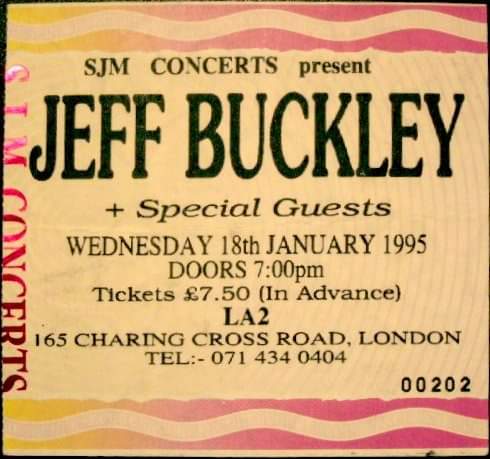
Astoria II

Today's gig is from London's Astoria II on January 18, 1995. Audio is a bit low in places, but not bad over all I think...I love the "Eternal Life" redo and the fantastic "Killing Time" cover in particular...Enjoy!


Setlist:
  1. Dream Brother
  2. So Real
  3. Grace
  4. Last Goodbye
  5. Eternal Life (aborted)
  6. Eternal Life
  7. Killing Time
  8. What Will You Say
  9. Mojo Pin
  10. Lover, You Should've Come Over
  11. Hallelujah (with improv)
  12. Vancouver
  13. Kanga-Roo


RIP


The location now 

New Jersey Beat

Making It In: New York : Jeff Buckley

A famous father, drop dead good looks, talent up the wazoo, a major label deal after just two years of playing gigs...Some guys have all the luck.
Jeff Buckley certainly seems to have been touched by providence, which may be why he titled his debut album "Grace". But life hasn't been all lollipops and daffodils. Buckley barely knew his father, folksinger Tim Buckley, who died when Jeff was still in grammar school. Jeff Buckley came to New York with an acoustic guitar and a pile of songs he'd written in Los Angeles, and started playing every coffeehouse, open mike, cocktail lounge, and folk club he could find. Barely two years later, he was signed to Columbia Records and releasing his first record, the CD5 "Live at Sin-E'." Who says you can't make it in New York? The question is, how? So we asked.
- Jim Testa.

Q: Are you from New York originally? Or were you one of those guys who just showed up at the Port Authority one day carrying your suitcase and guitar?

Jeff: Well, in my case, it was more like JFK airport. But I was living in California, in Los Angeles, before I came to New York. That was 1990. But I didn't really start gigging in New York until '92, maybe late '91.

Q: And that's when you started playing at Sin-E'?

Jeff: (corrects my pronunciation) Shin-ay. Right. And other places too. First Street Cafe, Cornelia Street Cafe, Bang On, Tramps, the Knittting Factory. Anything I could find, basically. Over and over and over and over again. So I don't know what I can tell you. The only way to really make it - anywhere - is to put every bit of your being into the thing that only *you* can provide. The only angle is the art that you choose, that only *you* can provide. And to do that, you have to be quiet for a long time and find out what you bring forth. You have to know what's in yourself - all your eccentricities, all your banalities, the full flavor of your woe and your joy. What does it look like? What does it feel like? What makes it different from everybody else's. It's totally subjective. You're just given the task of bringing it up.
It's like going up to some girl with a guitar and saying, "you are the only one, right now, who can make your music. Right now. You don't even know how to play the guitar. You'll find it, you'll find that chord, if you express your hear, *now*. You'll find that small inner platinum mine, that reservoir. It's something that's there, you just have to dig deep and find it. But it's something you have to do yourself. It's not something that can be pulled out of you by any teacher, not any that I've ever met. None. Close friends can tell you when you're finding. Other people who are out there doing it, they're good to talk to. But you have to find it yourself.

Q: The thing you hear all the time from bands is "there's no place to play in New York." When, of course, there are lots of places to play in New York, there just aren't a lot of places where you can play to a decent-sized audience and make any money on a regular basis.

Jeff: There are a thousand places to play in New York.

Q: Your experience would suggest that it doesn't really matter where you play, it's the playing itself that counts.

Jeff: That's it exactly. You can make a very sacred place out of The Speakeasy (a decrepit old Lower East Side bar.) If you put enough heart into it. Or you an turn it into a complete circus. You can do anything you want, anything. I've seen it all. You can blame the sound system sometimes. If you're a band, and the sound system sucks, there's nothing you can do, you're fucked. But if the sound system sucks, then you just mix yourselves on the stage, you turn up or turn down until you make it sound okay, and you use what little you have. There are always angles around technology, around managers, around people. But when you put the music forth, when you put the art forth, the performance piece, whatever, the heart of what you do speaks for itself. And that's what you go with. You lead with that. Each time. Every time. Every second. Sure, you need to be aware of technical things, and take care of them whenever possible, but your salvation lies in what you and your friends together have. What, you're going to blame the Pyramid for not getting a record deal? Your band broke up because the soundman at CBGB was in a bad mood last week?
The thing is, I *never* went and pursued a record deal. Ever. It's too funny to even talk about. It's like playing craps in Vegas. You know the odds belong to the house. You'll *always* lose. If that's why you're up there doing it, forget it. You're already fucked.

Q: Unfortunately, I've started seeing that more and more. You find these bands and you talk to them, and the only reason they want to be in a band is because they want to get signed. It's like they don't even know why they're making music.

Jeff: Really? That's sad. That happens all the time in Los Angeles, so I'm sort of used to that being the standard by which bands are measured - by how ambitious they are about getting a deal.

Q: I think Los Angeles was always more upfront about it being a place where bands would go and play the Strip and get signed. New York never used to have that mentality.

Jeff: That's true. Although on the upside, even thought they're a lot farther down in the underground, there are bands in Los Angeles who have nothing left in their lives except their music. But in New York, there's more of an expectation of hunger - ravenous, and angry - for originality.
Sure, there are always people who are only there because they want to get signed. And in a way, that's not a bad way to go, because the laws that govern the music business sort of point you in that direction anyway. It's like everything is set up for the people who want to be most famous. And if that's the place for you, baby, then go for it. But otherwise, it's a complete 24 hour a day dilemma. And let me just say that this is a very hard thing to judge from the outside. It's really difficult to just hang a label on someone and say that they're only in it to be rich and famous. Because it is a completely confusing universe.

Q: Okay, but let's take a band that's in it for all the right reasons. They're competing with hundreds of other local, unsigned bands who live in that area. And they're also competing with hundreds of bands from all over the world who come through New York on tour. So it seems almost impossible for any one band to get itself noticed in that total melee. And having watched your career, it seems to me like your approach to that wasn't any gimmicks, and you just kind of seperated yourself from the pack by being good at what you do.

Jeff: Yes, I guess you could say that. And that's a tremendous compliment. But how do you think those (industry) people got there? It was because of my association with one industry person. Somewhere down the line, even if it's something you don't actively pursue, it has to be somebody who knows you. One person, two people. The people who will always be my joy were the people who were there at the beginning. And we've had a dialogue since dirt was invented. And that's my audience. And one of those people happened to be music business people, and once *that* circuit gets started, it's like a huge chain reaction, a domino effect, all those cliches. They come either to dispel the rumor that what their friend is seeing is good, or to totally get on it, so they can be a part of it. That's not real, though. Those aren't real people. Because that industry thing, that buzz, that can always be taken away. But what real people feel, that's there. Don't get me wrong, there are record company people who are real people, who really love music. But the aspect of those people that represents their role in the music business, that can come or go. What's real is the people who come to see you just because they're into what you're doing. And who get into music to experience it, not to judge it. They will always be there, as long as you keep your heart open and strong.

Q: To be honest, I've been around the music business for about ten years, and I really do think that the kind of people who are working in the music business now are much more into music, and less into the business end of it, than people in those jobs would have been, say, ten years ago.

Jeff: That's true. It is a very, very different environment today. I've been watching it for a long time, and it is a different place. The people I deal with at Sony are just like me. They're there because they like the music and they just happen to have a job there. It's communicating, and agreeing or disagreeing with people, that's all it comes down to. In the music business, ideas are like cigarettes in prison. People sell them, people steal them, they're gold. Even if you don't smoke.

Q: What sort of experiences did you have with the local press before your album came out? One common complaint is that none of the local papers in New York have any interest in writing about the local scene.

Jeff: Good. I think that's good. Are you kidding? The last thing I want in my neighborhood are a bunch of people who are down there because they think they should be down there. People should come of their own volition, not because some guy in the paper says it's cool to go.

Q: But doesn't that just make it that much harder for bands to get noticed, to separate themselves from the throng?

Jeff: I don't know. New York Newsday said I was stealing from the black man, and I was failing at it whereas Michael Bolton was succeeding. So fuck 'em. The Village Voice...they don't know what's going on. The press doesn't matter unless the people on the staff love you. Then, yeah, they can help your career. People on the staffs of the dailies here don't love me, so who cares... But anyway, you can't judge yourself through the eyes of journalists anyway, because they will always be on the outside of the process, and never know anything, deeply, about your art, even though they will continue to make pronouncements about it. If they ask you questions and you tell 'em, then fine, that's accurate. And yeah, press helps. It does help. But if you're looking for humanism in it, forget it, it ain't gonna exist.

Friday, December 1, 2017

Feral

Jeff Buckley: a cool and clever cat.
Tivoli, Dublin, January 14, 1995
By Bill Prince
Q, March, 1995

It's probably just as well that pop stars cannot be assembled at a pick 'n' mix counter, or there would be dozens of Jeff Buckleys already: the faultless lineage (son of troubled troubadour Tim-but you knew that already); a voice that leaves most other singers trailing in it's quiksilver slipstream; looks that would give the young Paul Newman a canter for his coinage; all gift-wrapped in the kind of critical acclaim that in normal circumstances, can usually be relied upon to take a hectic detour around such seemingly mutually assured seduction. 

Paradoxically, the statistics are, on paper at least, less thrilling: Buckley's debut album, Grace, has sold a little over 30,000 copies in the UK since its release last August, and tonight's European tour opener at the medium sized Tivoli Theater would suggest only a relatively minor leap in stature since last Summer's 400 capacity Whelan's show.

Then there are those who will remind us that the same that at the same age (28 ), Buckley Sr was already dead having recorded eight albums of artistic affluence. Yet it's just this slow-burning buildup that seems to have got everyone so transfixed, evidenced by the countless low-key living room size gigs the solo Buckley has played over the last few years (documented on the four-track independently released EP Live at Sin-é), or the ineffable confidence that prompted him to assemble a band just three weeks before the recording of his major label debut. A debut, furthermore, that belies its stall-setting status to revel in its own joyous sweep, the sort of reckless daring that allows a clutch of idiosyncratic covers (Leonard Cohen, Benjamin Britten and after an anti-fashion, Elkie Brooks) to rub shoulders with swooning hymns to the fault-lines to which the path of true love must forever yield. Here, surely, was an artist for once seriously prepared to rattle the bars of his own, albeit gilded, cage...

Unsurprisingly, Jeff Buckley is proud of Grace, but shugs simply of its end-of-year-poll-winning positions: "There's no way you can predict the effect of an album." His is a cavalier attitude fueled by Marianas Trench-deep reserves of self-confidence. His own horizons are not hard to fathom: limitless would be the word that springs most likely to mind, if only for the way he'll take a simple enquiry after the health of his, frankly, hoarse voice: "Sometimes you have to hammer into shape. There's a balance between being protective with it and being wanton and brutish", or the way he'll essay a whole stream of theories that call upon Maria Callas, Robert Plant, and Soundgarden's Chris Cornell as witnesses to the debilitating effects of "high Cs and all that stuff. It's just fucking havoc". Buckley's equally sanguine about the possibilities that the steady growth of the Grace fanclub may well soon afford. Enormodomes must surely beckon.

" I love small places," he counters. "We can't really afford to do them right now, but in the future I'd really like to do, like residencies, two or maybe three nights in each city in really small clubs.

"The only way I can see changing a giant stadium into a really intimate space," he adds, "is by writing like Hey Jude where everybody knows it and it goes right through you. So the writing would have to change. But I like the environment of a small gig better. People come to clubs to drink and to be with friends; to get laid and fall in love, or maybe to forget and even get depressed. It's an emotional kind of place. But people go to stadiums to eat hot dogs and get beer and buy souvenir T-shirts. It's not the same thing."

Directly adjoining the tin-roofed playhouse (now showing: Happy Birthday Dear Alice, "a hilarious new comedy by Bernard Farrell"), The Tivoli'a consequently post Saturday night stage time of 1 a.m. does little to dissuade the hard-drinking denizens of Dublin. In a city where the cab drivers are as likely to be grooving to Ry Cooder and Ali Farka Toure as they are arguing along to talk radio, there's a little point drawing conclusions from the staggeringly heterogeneous crowd. Clearly music fans all, there is nevertheless a hard core at the front who loudly proclaim themselves to be disciples. That said, the unheralded arrival of Buckley and his band comprising old friends, only recently tested in environments like this (drummer Matt Johnson, guitarist Michael Tighe,  and bassist Mick Grondahl-as unfamiliar with the ugly stick as their leader, it should be said) goes unnoticed until-house DJ finally silenced-the refusal of Buckley's amplifier to spark into life eventually draws gazes to the stage,  eliciting the first of tonight's many "ooohs" as his taut, almost feral frame settles, unfazed by this potentially embarrassing false start, on the edge of the drum riser.

Power restored, the band launch into Dream Brother, the fabled paean to Buckley père, although according to its author concerning instead his close friend, ex-Fishbone keyboards and trombone player Chris Dowd ("I just wanted to sing about a man instead of a girl"). Immediately, Buckley's muzezzin wail is disturbing the rafters and the audience is already going hipswayingly ape shit at all this wobbly, warbling witchcraft.

So Real is just like the record, only louder: no mean feat considering the serpentine, voluptuous sound of the album and the strictly conventional line-up of two guitars, bass and drums upon which the Buckley voice is currently prostrated. So it is with The Last Goodbye and Eternal Life: the latter to all intents and purposes Helter Skelter recast with the metallic precision of grunge. This, and a "new one" What Will You Say (coincidentally written by the former Fishboning friend), point to a possible firming up of Buckley's predominantly eerie, edgy canon; signaling too, perhaps, a resolve not to be forever cast as the unkempt angel with the gossamer vocals.

Nor does Buckley limit himself to merely showboating with that flummoxing vocal range of his, instead often taking the very tenor of his voice and casting it off in all directions, his head shaking so violently as to raise doubts about the long-term effects the style might have on that blessed larynx.

Lilac Wine, the oddity in Grace's already oddball trio of covers, is, in stark contrast, delivered in such hushed tones as to be effectively drowned out by the audience "shhhhh"-ing the drinkers at the bar. Mojo Pin and Grace both rage with the vocal triumphalism of someone for whom failure seems to hold no special terror, while as if to counter these exertions (and prefaced with a warning "I'm nursing a cold"), the headily spiraling Lover, You Should've Come Over opens out from a smoldering, gravely register.

It's a little after 2 a.m. when Buckley returns alone for the solitary encore, finding the wide open spaces in John Cale's reading of Cohen's Hallelujah before, and, just as the voice is finally grounded ("I can't sing anymore") calling a halt to the proceedings with a graceful ark into the delighted crowd.

Upstairs afterwards, a phalanx of Euro rock hacks swiftly encircle the man in the mouldering fake fur coat and busily feed him Grace CDs to be autographed. Eventually the arrival of a close female friend offers an escape route into the night, which the shattered and coughing Buckley gladly takes. How much longer he'll be allowed such an easy exit from the clamoring corporate rock maw remains to be seen...

Valley Art Theater

As I accidentally forgot to post it on the anniversary, today's gig is from the Valley Art Theatre in Tempe, AZ on November 26, 1994, featuring my favorites of "The Time Warp" and a bit of the "Pink Panther Theme"...enjoy! ☺ (website)


Setlist:
  1. Chocolate/Mojo Pin
  2. The Time Warp
  3. Grace
  4. Dream Brother
  5. Eternal Life
  6. Last Goodbye
  7. What Will You Say
  8. So Real
  9. Hallelujah
  10. Lover, You Should Have Come Over
  11. Pink Panther Theme
  12. Kanga-Roo


Rebel, Philosopher, And Music Man

Inside Edge: December, 1994
By Matt Leinwohl

Hanging out with Jeff Buckley would be any music journalist's wet dream,as he goes on and on about *everything*. The only thing that surpasses his worldliness and intellect is his music. It is a beautifully atmospheric mix that does justice to his influences, which range from Led Zeppelin and Joni Mitchell to Bad Brains and Judy Garland!
Just casually shooting it, Buckley was extremely gracious and charismatic. Even though the comparison will probably make him cringe, he reminded me of James Dean, as not only does he resemble Dean with longer hair, but he has that same lone-wolf, soft-spoken demeanor. So, sit back, relax, and enjoy the wisdom of someone you'll be hearing about for a long time.

Inside Edge (IE): What was it like for you rowing up? Were you a misfit? Or were in the "in crowd?"

Jeff Buckley (JB): I hated high school! I don't know, really wear it (being a misfit) as a badge of honor. My family would always be moving so I was always the new guy in town. Any school I went to, I would always be introduced to the class, (angrily)...which by the way, teachers, is a stupid thing to do. By being in front of the class, I would be judged at hand immediately. I could see which person wanted to kick my ass, which weren't the ones who got their asses kicked, and which ones did the ass-kicking. So, each time I had to start the process over and over again, and I was always singled out. Kids are cold and disgusting because they learn it all from their parents. The last place I ended up going to school was Orange County High...f-cking Orange Curtain! Hangin' outwith the good ol' Nazi youth! By then, I was skipping school to play clubs.

IE: So you never went to college?

JB: No, I couldn't afford it...and I had no desire. I had the desire for higher learning, and that's why I eventually dropped out of school.

IE: It seems like music from the 60's/70's is making a huge comeback. Rock'n'roll in the 90's is going though a terrific renaissance. But with that, drug use is now more common within our generation. Do you think it's a coincidence, or is there some sort of connection?

JB: The establishment and the media have given such a dose of prevention and prohibition. It's the big slap on the hand. All of this results in a rallying cry to get messed up, have sex, and put out music. It's not that the 60's are happening again. Mommy Reagan said (in an old lady's voice), "Just say no! Don't do it!" Now we've got a young president...who has SEX! Seriously, he's trying to clean up the sh-t that Reagan and Bush left. The sh-t that our children's children will be paying for. But starting with Clinton, he's the cleaner-upper and he's having a hard time with it. (sarcastically) He just happens to have a d-ck!! I don't know...regarding music today, there really ain't no more rules any more. I don't know if we're recalling the 60's, but it seems like we're all getting up and playing music. So many things are considered "alternative," but I could put on "Funhouse" (The Stooges) right now and clear the f-cking room. That's alternative!! (laughs) It's really funny how bands want to be seen as having "street value." Street value is just another commodity that can be bought and sold. Be careful!

IE: The material on your E.P. ("Live at Sin-E") and "Grace" is very atmospheric. What inspired you to write "Mojo Pin" and "Eternal Life?"

JB: No matter how much you love somebody, sometimes there's always something that'll take them away, even if they love you. In "Eternal Life"...I don't know, I was just angry, I couldn't sleep. I was angry for weeks, and I didn't know exactly why. But, I kept thinking about how people sometimes just try to live their lives, to raise kids, to go to work, and to have good sex with their men, whatever. Somewhere down the line, there's somebody F-CKING with them. Either it's old company boys in Washington, or it's a deranged lunatic that'll raise the blade and send them away forever. There's so many things about trying to be a human being that people don't even have a handle on...what they keep on emphasizing in their lives are really violent things that hurt other people, which are really just reflections of them. They refuse to look at themselves, so they take it out on you. Women do it to men all the time, people do it to people.
Y'know, it's just about that...and it goes into racial prejudice. I also see traits or "sins" and how they're passed down to our children by default. The issue itself is so insidious, I cannot tell you what it does to me to pass this down to a child. Passing down your own frustrations and anger is like poison. Then there's the KKK, who have their kids grow up to be murderous Nazi f-cks! You can't print that! It's insane! I'm not talking about raising your kids to be completely passive, just raise your kids to understand, because you have to raise yourself to understand. I don't know, at least that's what "Eternal Life" is about. You think...whoever you are...and even myself...if at one point you think that messing somebody up, for something that you can't comprehend is where it's at, then it's too late for you already.

IE: By the way, did you ever hear about Ted Nugent's take on the whole Kurt Cobain situation?

JB: No, what did he have to say?

IE: Well, he was very unsympathetic towards him, and he called him a pussy...

JB: (visibly enraged) Who's more of a pussy?!! Someone who ends their pain, or shoots a fuckin' deer with a 12 gauge?!!! Eat my dick Ted!! (calms down) Or someone who joins the Damn Yankees (laughs uncontrollably)?!! (turning serious) It's not within anybody's judgment to judge Kurt, alive or dead. That's why people put other people on pedestals, so they don't judge themselves. Hell, I can't even judge Ted Nugent.

IE: Do you sympathize with someone like Eddie Vedder? People are always labeling him as the "next Morrison."

JB: Anyone who says that someone is the next so-and-so is either deluded or a rock critic. Eddie is a completely different animal, he'd...he's hurtful, you know? he hurts. He's not that kind of writer. I don't know, who's the next anyone? F-ck that sh-t! I wouldn't want to be the next Morrison. Jim would probably say "What're you doing? Don't be me!" Everyone's looking for the next Jesus Christ, the next Elvis, the next Lennon. It's impossible, it'll never happen, and your expectations will be completely dashed everytime. Just let people be who they are.

IE: Are you prepared for success and all it's trappings? Right now you seem to be on top of the cusp of something very special.

JB: I don't know if there's place out there for me. I know that I'm happy with the music and the performance, and that's what counts. The only bad thing about coming into this business is that I now know how things can be marketed. It's like if this person looks like a star, let's make him into one. It's just like that Brady Bunch episode where Greg is Johnny Bravo. That's exactly the way it is, except the only thing is, there are actually talented people out there. Y'know, Bill (Corgan) can actually write a f-ckin' great song, he can actually do what he does...It's a weird thing...as long as it's real.

IE: Does the thought of being famous excite you? Or does it frighten you?

JB: You don't need to own the world when you're 27. You don't need it when you're Leonard Cohen's age, at the height of your powers. Look at Tom Waits, he's still f-cking jamming! (long pause) Y'know, I'm really honored that you like my music, but it's odd. I didn't write "Anarchy in the U.K.," "Won't Get Fooled Again," or "the End." I don't know... I guess I'm just whining, that's all.

IE: You have a very distinctive singing style, especially with the high falsetto. Who influenced your singing?

JB: People like Bessie Smith, Pink Floyd, Joni Mitchell, Deep Purple, the soundtracks to the "Wizard of Oz", "Funny Girl", and "Led Zeppelin II."

IE: Just from watching your soundcheck, you'd have to be a fool not to notice the Plant influence, especially the young Plant.

JB: That's cool, 'cause that era was when he sounded most like a woman.

IE: What Joni Mitchell record affected you the most?

JB: "Clouds" and "Court and Spark." I'd listen to them over and over again as a kid. But getting back to the current music scene, it's great that we have Pearl Jam and Alice and Chains in such an influential position. It's cool because, just think what'll come afterwards.

IE: Do you have any final words, thoughts, or comments?

JB: I love you! And thank you! Actually, if I had to say anything it'd be have fun, use a condom, and PLEASE don't listen to me as your guide.